Sunday, April 28, 2013

Movie Review: Jack Reacher


1. Short review: 

2. Long review:
2.1. What I liked: Tom Cruise's performance: 'He looked little and pissed-off.' (Kristine Kathryn Rusch)

2.2. What I did not like: The bad guys' motivation was not clear to me. Money? Geez, in this world, if you got money and want more, get a McDonald's franchise. Or a Starbucks.

2.3. Who I think is the audience: Everyone.

2.4. Is the movie appropriate for children to see? Yes, with a caveat. There is violence, but the personal violence is movie violence: gunshots with no spatter and no blood. However, there is a sniper shooting that is replayed several times. Your call.

2.5. On the basis of viewing this movie, will I pay to see the sequel? Yes, I will pay to see another Jack Reacher starring Tom Cruise.

2.6. Rating and the plot in a nutshell:

2.6.1. How I rate movies:
-- I want my money back.
-- Worth a rental, not more. 
-- Worth first-run theater price once. <-- Jack Reacher
-- I will pay first-run theater price to see it again. 

Running time: 130 minutes.

2.6.2. The plot in a nutshell:
     Mass sniper shooting in Pittsburg. Cops arrest suspect. Asked for a confession, the suspect writes 'GET JACK REACHER' on a tablet.
     Jack Reacher shows up. Investigates the incident for suspect's defense attorney. Uncovers nefarious plot. Kills all the bad guys. Leaves town.
2.7. Other:

     I saw this on pay-per-view. I liked it. 
     Kristine Kathryn Rusch noted that Jack Reacher found a poor reception among fans of the Lee Child books. Evidently they were upset because 5'8" Cruise was chosen to portray a 6'5" character.
     I have not read any of the Jack Reacher books, so I had no expectations about the man's size. But thinking about it, if the guy is 6'5" I expect him to be capable of handling himself in a brawl. At 5'8", it comes as a brutal surprise.
     There were three fistfights in the movie. In the first, Reacher took on five toughs and sent three to hospital. The last two escaped that fate by running away.
     Cruise brought the attitude of Reacher out on the screen. He looked bored by the prospect of a fight with five toughs. To get the fight started, he even said, "Look, it's getting late." When the fists flew, he savaged his opponents. No Marquess of Queensberry rules for him. He dealt each blow to stun or disable. Kudos to whomever choreographed that fight.
     The movie's bad press persuaded me to avoid it in the theaters. That's too bad. I enjoyed it.
     YMMV.

2.8. Links:
IMDb review
Rotten Tomatoes review

Saturday, April 27, 2013

eBook Review: Retief!


Keith Laumer, Retief!


Product Details from Baen's Books

Published ?
SKU: 0671318578
Ebook Price: $4.00
Not Currently Available (As of 26 April 2013.)

1. Short review:  (Amazon rating: 5 out of 5 stars -- I love it.)

2. Long review:
2.1. What I liked:  I am a fan of Jaime Retief. I think the Retief series was the best that Keith Laumer wrote. 
Roller-coaster or walk-in-the-park? Roller coasters, but old wooden ones. None of the new loopty-loop let's-get-inverted roller coasters. Still, good rides. 

2.2. What I did not like: Eric Flint's afterward. Eric Flint is not a fan of Retief. Said he liked KL's "In the Queue" better. I read "In the Queue". Once. I have read Retief! many times. This is the first time I read it in ebook form.

2.3. Who I think is the audience: Science fiction fans. KL fans.

2.4. Is the book appropriate for children to read?  Yes. No worries.

2.5. On the basis of reading this book, will I buy the author's next book? Yes.

2.6. The plot in a nutshell:
     There are many stories, so there are many plots. The headliner is "Diplomat at Arms", the first Retief story. Curiously, this is the story of the end of Retief's career with the Corps Diplomatique Terrestrienne, aka the CDT.
 2.7. Other:
     KL served in the US Air Force. After honorable service with the hardest-working branch of the military, for inexplicable reasons he chose to consort with liars and villains: he joined the Foreign Service.
     Jerry Pournelle wrote that, in training, KL had to lie on the ground while a tank trundled over him. Seems like a damned silly thing for an Air Force officer to do, but Jerry says that experience informed KL's Bolo series. Bolos were AI tanks with no human operators. Myself, I never cared much for the Bolos. How do you root for cold metal versus men? I dunno. For tank action I prefer David Drake's Hammer's Slammers. Men in iridium AFVs doing unto others hot, hard, and heavy 'cuz it's their job and they're good at it.
     Retief is my favorite of KL's series. Like Harry Harrison's Stainless Steel Rat, each story -- "Diplomat at Arms" excepted --  is filled with droll humor.
     Eric Flint does not appreciate Retief and says so in the Afterward to this volume. Says he prefers KL's "In the Queue". I do not know Mr Flint, but based solely upon his stated preference here, I do not think he and I can be friends. If he would rather read "In the Queue" than "Diplomat at Arms", he is too twisted for my tastes. Why Baen's Books did not get someone who is a fan of Retief, anyone but Eric Flint, to write the Afterward beats me.
     Look. I love the Retief series. Retief! is the first volume of the collected stories among many. I read it many times and enjoyed each reading.
     YMMV.

2.8. Links:  There are entries in Wikipedia for Keith Laumer and Jaime Retief, but they are so bad that I refuse to link to them. An example of how bad they are, the entry for Jaime Retief consistently misspells his name. If you can't be bothered to get the name right, don't bother making the entry at all.  

2.9. Buy the book:  Retief! (Oops! Not currently available from Baen's Books. Big mistake on their part. Huge. Click the link anyway. Maybe by the time you try it they will have had a lucid moment and made it available. I mean, it was available. How hard is it to link to an ebook file? A link that used to be there?)
     HEY! You guys at Baen's Books. When will you make this right?

     CAVEAT EMPTOR: The Amazon listing for Retief! is "The Yllian Way", a single Retief short story. It is not the full first collection. 03 November 2013.

Saturday, April 6, 2013

eBook Review: Assignment in Eternity


Robert Heinlein, Assignment in Eternity

Product Details from Baen's Books

Published 7/1/2012
SKU:
9781451637854B
Ebook Price: $8.99 


1. Short review:  (Amazon rating: 4 out of 5 stars -- I like it.)

2. Long review:
2.1. What I liked:  "Jerry Was a Man" and the Afterward by David Drake. "Jerry Was a Man" is a 5-star story. 
Roller-coaster or walk-in-the-park? Both. Four stories are collected in this volume. Some coasters, some walks.

2.2. What I did not like: Sad to say, I have never liked "Lost Legacy". Read it years ago and forgot it. Reading it again, I remembered why I forgot it.

2.3. Who I think is the audience: Science fiction fans. RAH fans.

2.4. Is the book appropriate for children to read?  Yes. No worries.

2.5. On the basis of reading this book, will I buy the author's next book? Yes.

2.6. The plot in a nutshell:
     There are four stories in Assignment in Eternity: "Gulf", "Elsewhen", "Lost Legacy", and "Jerry Was a Man". David Drake's Afterward tells us where these stories were first published and how they came to be published.
     "Jerry Was a Man" is the reason I bought the book. This story alone is worth the book's price.
     Jerry was a 'worker', the product of gene engineering from chimpanzee stock. Billionairess Martha van Vogel found him in a pen of 'retired' workers at Workers, Inc., and took a liking to him. When she discovered that Jerry and his cohort were to be terminated because they were no longer economically viable, she raised a fuss and called her stockbroker (by cell phone) to direct him to purchase controlling interest in the corporation's stock. To smooth things over, Workers, Inc., made her a present of Jerry.
     Mrs van Vogel found her attempt to gain control of Workers, Inc., blocked. She sought another way to prevent Workers, Inc., from terminating retired anthropoids. What she found was lawyers. They have Jerry sue Workers, Inc.
     The key questions in the case are two:  1) What is a man? and 2) Is Jerry a man?
     The problem with the story is that the title gives away the ending. But it is still a great story.
     Why is it a great story?
     I have my view of science fiction. My view is that nobody writes about the future. We write about matters of today using the lens of science fiction to magnify some specific concern.
     "Jerry Was a Man" was published in 1947. When RAH wrote the story, blacks were segregated by law. RAH was making a point about racial injustice. If a gene-engineered chimpanzee was a man, was a black human being anything less?
 2.7. Other:
     FYI Rod Walker, the hero of Tunnel in the Sky, was black. No less an authority than Virginia Heinlein, RAH's wife, said so.
     Johnny Rico, the hero of Starship Troopers, was Filipino.
     RAH believed in the equality of men before it was fashionable. He believed that a man is not defined by the color of his skin but, rather, by the quality of his acts.

2.8. Links:  The Heinlein Society 

2.9. Buy the book:  Assignment in Eternity

Tuesday, April 2, 2013

eBook Review: Spitfires, Thunderbolts, and Warm Beer


Philip D Caine, Spitfires, Thunderbolts, and Warm Beer: An American Fighter Pilot Over Europe

Product Details

  • File Size: 4211 KB 
  • Print Length: 231 pages 
  • Publisher: Potomac Books Inc.; 1st edition (February 28, 1995) 
  • Sold by: Amazon Digital Services, Inc. 
  • Language: English 
  • ASIN: B004NNUV72 
  • Text-to-Speech: Enabled 
  • X-Ray: Not Enabled 
  • Lending: Not Enabled
  • Average Customer Review: 4.5 out of 5 stars (28 customer reviews) 
  • Price: $9.16
1. Short review:  (Amazon rating: 4 out of 5 stars -- I like it.)

2. Long review:
2.1. What I liked:  Well written. Caine crafted an excellent book from Gover's letters, war diary, and interviews.
Roller-coaster or walk-in-the-park? Roller coaster.

2.2. What I did not like: I wanted a table of Gover's missions and kills, but maybe that is asking too much.

2.3. Who I think is the audience: Air combat buffs. History buffs.

2.4. Is the book appropriate for children to read?  Yes. No worries.

2.5. On the basis of reading this book, will I buy the author's next book? Yes.

2.6. The plot in a nutshell:
     There is no plot, but it feels like there is. The tension rises steadily until LeRoy Gover returns home on leave in 1944.
     LG learned to fly during the Great Depression. When he signed up for the Selective Service, he realized that without two years of college he would be shunted to the infantry when drafted. He searched for and found a way to become a fighter pilot: join the RAF.
     The RAF concocted an oath sort of like the one the French Foreign Legion used so that American volunteers would not lose their citizenship. Before he swore the oath, LG took 'refresher training' on AT6s in Bakersfield. Not every student in his class passed. He did.
     Most American volunteers were used as instructors in Canada. LG was slated to become a fighter pilot.
     LG sailed to England by way of Canada. He joined his Operational Training Unit in Wales. After he finished his training, he cycled back to instruct the next class. Then he joined 66 Squadron in early 1942. When he joined, 66 Squadron flew the Spitfire Mk V. 
     The only American in the squadron, LG flew the full range of fighter missions: bomber escort, convoy patrol, and fighter sweeps -- the British term for ground attack. The day of the Dieppe Raid, 19 August 1942, 66 Squadron flew top cover for the ill-fated Canadians. (Why did the British high command always throw away commonwealth forces in ill-conceived adventures like Gallipoli and Dieppe?) LG flew three missions over Dieppe that day. On the first mission, the whole squadron flew. On the second mission, there were only five planes in the squadron that could fly. On the third mission, the squadron consisted of three aircraft; only LG returned from that mission, his Spitfire riddled with bullet holes.
     LG received orders posting him to 133 Squadron the next day. 133 was an Eagle Squadron; that is, its pilots were all American. LG spent a month with them before the US Army Air Force absorbed the Eagle Squadrons.
     LG went from a Flying Officer in the RAF to Second Lieutenant in the USAAF. He still flew Spits but with a star instead of a roundel.
LeRoy Gover flew a Spitfire with these markings from late September 1942 to January 1943.
     The USAAF primary fighter mission -- bomber escort -- differed from that of the RAF, and the Spitfire was ill-suited to the mission. In January 1943 LG traded his Spit for a Jug, a razorback P47. (In the book's cover photo he is seen about to enter his P47.) LG was promoted captain about the same time and became a flight leader. USAAF regs said a pilot had to have 50 hours in a type before flying combat, so LG did not fly another mission through enemy skies until 10 March 1943.
     The day before Christmas 1943, LG's squadron commander told him he was being sent home on leave. Due to SNAFUs with his leave orders, LG did not leave England until March 1944. He spent the rest of the war commanding a fighter lead-in squadron in Florida.
 2.7. Other:
     Along with stories of Spits and Jugs, LG gives much print to the free time he spent in London drinking. Thus, the warm beer in the title.
     LG transferred to the USAAF for the insurance ($10,000 in the USAAF; 0 in the RAF) and the pay. His pay increased from $58 a month in the RAF to $300 a month in the USAAF. As a second louie.
     The book contains 31 photos. One that impressed me was the photo of LG's OTU class. 30 members of the class were marked with Xs and 7 with Os. X denoted someone who was killed in the war. O denoted someone who had crashed and was unfit to fly. Six in the class survived the war still flying. You got that? 30 dead out of 43 and another seven too broken up to fly again. And grunts complain us flyboys have it easy. Hmmph.
     LG retired from the Air Force a full bird colonel in 1962. Flew charters to Mexico and Canada after that.
     There is much more in this book, but I won't spoil it for you. Read it for yourself. It is excellent.
     One last thing: I was surprised to find the tension rose in this memoir as if it were a novel. I felt relief when LG was ordered home on leave.
     Okay, one more last thing: LG got 4 kills with the RAF and 2 with the USAAF. The USAAF did not count his RAF kills and the RAF did not track his USAAF kills, so by the official records he is not an ace.
     Okay, okay, one last last thing: Members of the Eagle Squadrons -- USAAF pilots who had flown with the RAF -- in addition to their USAAF wings got to wear their RAF wings over their right breast pocket. How cool is that?
     LG died two and half years after this book was first published. His obituary (third from the top) differs from the book on details. I think the book is right and the obit is wrong.
     The author, BGen Philip D. Caine, USAF (Ret.), did an excellent job with this book. It is the best third-person account I have read. He was no slouch either. Look him up.

2.8. Links: 
LeRoy Gover with the 4th Fighter Group (Note: Despite the roundel on the Spitfire, the information on this page covers only LG's time in the USAAF.)
Philip D. Caine 

2.9. Buy the book:  Spitfires, Thunderbolts, and Warm Beer 

Friday, March 22, 2013

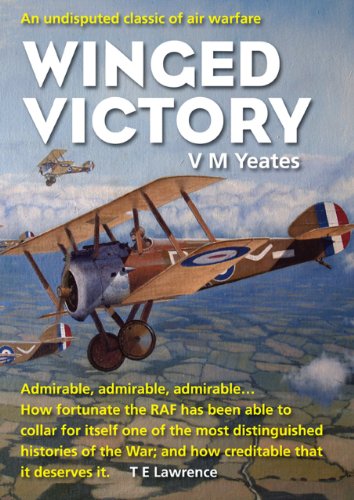
eBook Review: Winged Victory


Victor M Yeates, Winged Victory

Product Details

  • File Size: 813 KB
  • Print Length: 465 pages
  • Sold by: Amazon Digital Services, Inc.
  • Language: English
  • ASIN: B005FA3W8C
  • Text-to-Speech: Enabled
  • X-Ray: Not Enabled
  • Lending: Not Enabled
  • Average Customer Review: 3.0 out of 5 stars (3 customer reviews) 
  • Price: $8.99 
1. Short review:    (Amazon rating: 2 out of 5 stars -- I dislike it.)

2. Long review:
2.1. What I liked:  The accounts of combat flying. The book gave a perspective on Sopwith Dolphins that I had not seen before.
Roller-coaster or walk-in-the-park? Sometimes a roller coaster. Mostly a tedious afternoon listening to your great aunt rant about how terrible things are.

2.2. What I did not like: Yeates incessant rants against war, against its causes, and about how afraid he is. If you have ever seen Howard Hughes's Hell's Angels, you know it is 10 minutes of flying action prefaced by 2 hours of woe-is-me. Yeates does that same trick three times over.

2.3. Who I think is the audience: Air combat buffs. History buffs. Masochists.

2.4. Is the book appropriate for children to read? No. Nothing profane or obscene or lurid, but the main character spends his nights drinking himself into stupor.

2.5. On the basis of reading this book, will I buy the author's next book? No. Yeates wrote only this one book, but had he written another, I would not buy it.

2.6. The plot in a nutshell:
     There is no plot. Instead the book presents interminable rants from its hero -- Tom Crundall -- on the causes of war and their solution, the terrors of ground strafing, and Crundall's nightly drinking binges punctuated with commas of aerial combat.
2.7. Other:
     Victor Maslin Yeates began Winged Victory in 1933 when he was hospitalized for tuberculosis. He died the following year, the year Winged Victory was published. I want to believe it provided some money for his widow and children.
     VMY titled the work "Wingless Victor", but his publisher changed the title.
     I have read reports that RAF pilots in the Second World War read Winged Victory to discover better aerial combat tactics. If you compare Crundall's notes on the Sopwith Camel and the Sopwith Dolphin, you learn that it is better to be high and fast than low and slow. This is something the RAF fighter pilots did not learn in fighter school? Why did they not read von Richtofen's Der rote Kampfflieger or McCudden's Flying Fury or even Grinnell-Milne's Wind in the Wires? Any one of those books would give a pilot more information about flying combat and staying alive at it than Winged Victory.
     I refrained from blogging until I finished Winged Victory so that it would follow No Parachute in order. On reflection, that was a mistake.
     I am fond of First World War aviation history. It is rare for a book on that subject to get a negative review from me. VMY managed to do so.
     When VMY's alter ego Tom Crundall is in the air, the passages work; that is, they entertain and enlighten. But most of the time Crundall is on the ground agonizing about flying combat, scared witless, or blind drunk. He is an unattractive figure. I wanted him to get shot down to end my pain reading his rants.
    
     VMY flew with 46 Squadron, the same squadron as Arthur Gould Lee who wrote No Parachute.

     VMY crafted characters from his squadron mates. Tom Crundall was VMY but single; VMY was married when he went to war. The character Mac was obviously Donald MacLaren. I could not find a real-life figure for Williamson, Crundall's flight leader and tent-mate. VMY mentioned Debenham by name.  

     As of this writing, Amazon lists three reviews for Winged Victory: one five-star, one three-star, and one one-star. The five-star review is mostly about Henry Williamson, the man who wrote the forward for this edition. I doubt the reviewer, Terry Atwood, read the book at all.

     This book wasted my time. I recommend you read No Parachute instead. You will get the same message with more force and without the tedious whining of Victor Maslin Yeates.
     YMMV.


2.8. Links:  Victor Maslin Yeates

2.9. Buy the book:  Winged Victory

Sunday, January 20, 2013

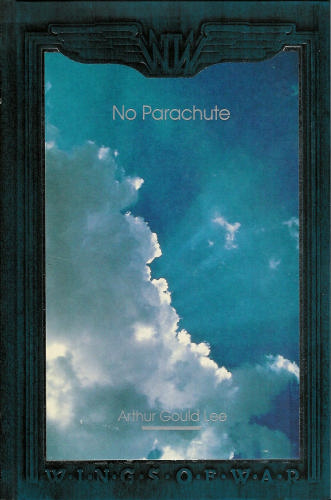
DTB Review: No Parachute


Arthur Gould Lee, No Parachute

Product Details

  • Hardcover: 233 pages
  • Publisher: Time Life Education (June 1991)
  • Language: English
  • ISBN-10: 0809496127
  • ISBN-13: 978-0809496129
  • Product Dimensions: 8.4 x 5.6 x 1 inches
  • Shipping Weight: 1.1 pounds
  • Average Customer Review: 4.8 out of 5 stars (9 customer reviews) 
  • Price: $48.80 plus shipping
1. Short review:    (Amazon rating: 5 out of 5 stars -- I love it.)

2. Long review:
2.1. What I liked:  The contemporaneous account by a flyer in the Great War. Of all the books I have read on air combat in the Great War, No Parachute is the best.
Roller-coaster or walk-in-the-park? Roller coaster.

2.2. What I did not like: The cover (see above). The cover is god-awful.
     The first edition cover is better but misleading. Here 'tis:
     The airplane in the foreground sporting the roundel on the fuselage and the Lewis gun on the top plane is a Nieuport fighter. This implies that Lee flew Nieuports. He did not. He flew Sopwith Pups and Camels.
     The 1971 mass-market paperback got it right; here 'tis:

The airplane in the foreground is a Sopwith Pup.
(Note the price on the cover: 95¢.)

     The non-scalable font. I have gotten used to e-books. I like to choose the size of the font I read. Not having that ability is an annoyance.

2.3. Who I think is the audience: Air combat buffs. History buffs.

2.4. Is the book appropriate for children to read?  Yes. No worries.

2.5. On the basis of reading this book, will I buy the author's next book? Yes. I plan to order Open Cockpit through Amazon soon. Afterwards, I may order Fly Past.

2.6. The plot in a nutshell:
     There is no plot, but it feels like there is. I could feel the stress tearing down the man. No Parachute is a memoir. Arthur Gould Lee compiled and edited this account years after the war. It was first published in 1968.
     To compile No Parachute, AGL used the letters he wrote to his first wife, Gwyneth Ann, during the Great War. She died before the book was written. The book is dedicated to her. AGL interspersed the letters with entries from his diary. He edited the letters to include places and details that the war censors took out.
     AGL broke a leg during pilot training. This caused him to repeat the course. Thus, he had more flying hours than most when he was posted to France.
     No Parachute begins 18 May 1917 with AGL in the pilots' pool at the aircraft depot at St. Omer. He was eager to join the war. 22 May 1917 he joined 46 Squadron at the Ypres front. Here he began to fly the Sopwith Pup, an airplane that was easy to fly but obsolescent by this stage of the war. He was the most junior pilot in the squadron.
     I shall not spoil the book for you by summarizing the action. But here is the last paragraph of AGL's letter to his wife dated November 24th[, 1917]:

     Now that Charles has gone [WIA], I've been flying longer in the squadron than anyone else.

     In 6 months AGL went from most junior to most senior pilot in the squadron. Think about that.
     In December 1917 AGL wrote his wife that, save for breakfast and tea, he had gone off his meals. For lunch and dinner, he substituted milk with brandy. 
     Both his squadron commander and the wing M.O. spoke to him about standing down. They knew he was cracking up. He replied there was nothing wrong with him that a good drinking binge would not cure. 01 January 1918, they ordered him to the Home Establishment.
     When he left the front, AGL had logged 12 1/2 hours of dual instruction and 386 hours solo. 222 of those solo hours were over the lines. He flew 118 patrols and fought 56 combats with 7 kills (AGL wrote 11 but not all were confirmed).
 2.7. Other:
     This is another classic of the war in the air during the Great War. Shame it is not available as an ebook.
     The book contains 17 illustrations and pictures and one map.
     Why No Parachute was published under the Time-Life Education imprint and Wind in the Wires was published under the Time-Life Reprint imprint, I do not know.
     AGL rose to the rank of RAF Air Vice Marshall before his retirement in 1946.
     The book includes three appendices: Appendix A, The Failure in High Command; Appendix B, Trenchard's Strategy of the Offensive; and Appendix C, Why No Parachutes? 
     The price given above is what I paid. YMMV.


2.8. Links: 
Open Cockpit
Fly Past 

2.9. Buy the book:
hardback with ugly cover: No Parachute 
hardback with misleading cover: No Parachute (used) 
paperback with pretty cover: No Parachute (used)

Wednesday, January 16, 2013

DTB Review: Wind in the Wires


Duncan Grinnell-Milne, Wind in the Wires

Product Details

  • Hardcover: 223 pages
  • Publisher: Time-Life Books; REPRINT Edition edition (1992)
  • Language: English
  • ISBN-10: 0809496291
  • ISBN-13: 978-0809496297
  • Product Dimensions: 9.9 x 7.9 x 0.4 inches
  • Shipping Weight: 10.4 ounces
  • Average Customer Review: 5.0 out of 5 stars (7 customer reviews) 
  • Price: $10.25 plus shipping
1. Short review:    (Amazon rating: 4 out of 5 stars -- I like it.)

2. Long review:
2.1. What I liked:  The first-hand account by an early (1915) flyer in the Great War.
Roller-coaster or walk-in-the-park? Should be both, but it is a walk in the park.

2.2. What I did not like: The cover (see above). The cover is god-awful. The 1957 mass-market paperback cover is also god-awful. The 1970 mass-market paperback is beautiful; here 'tis:

Ain't that pretty?

     The non-scalable font. I have gotten used to e-books. I like to choose the size of the font I read. Not having that ability is an annoyance.

2.3. Who I think is the audience: Air combat buffs. History buffs.

2.4. Is the book appropriate for children to read?  Yes. No worries.

2.5. On the basis of reading this book, will I buy the author's next book?  Maybe. Other than The Silent Victory, I am not interested in any other of GM's works.

2.6. The plot in a nutshell:
     There is no plot. Wind in the Wires is a memoir. Duncan Grinnell-Milne wrote it years after the war. It was first published in 1933.
     GM began with his flying school experiences. He learned to fly on a Farman Longhorn, a machine that could barely struggle into the air on a calm day.
     After pilot training, GM joined 16 Squadron and flew the BE2c, aka the Quirk. GM seemed to have liked the Quirk. For the life of me, I cannot think why. The observer sat in front with his downward view obstructed by the bottom plane. His rearward field of fire with the Lewis gun was obstructed by the pilot. Unmaneuverable and slow, the Quirk was a remarkably bad airplane in an era of bad airplanes. Still GM and his observer managed to down one German with it.
     GM did not enjoy his time with 16 Squadron. The Officer Commanding was a stuffed shirt who was more interested in keeping planes in running order than in accomplishing missions. Pilots were graded by the softness of their landings instead of the aggressive accomplishment of their missions.
     Soon after scoring his first kill, GM flew a reconnaissance so deep behind German lines that it required he leave his observer behind. Predictably, his engine packed up, and he was captured.
     GM spent 30 months in captivity and eight of those months were in solitary confinement as punishment for one escape attempt or another. Fabricating escape attempts seems to have been his hobby. He finally succeeded the day before he was to be paroled through Holland.
     GM returned to France to fly the SE5a with 56 Squadron. 56 was the most celebrated RAF fighter squadron of the Great War. GM noted that 16 Squadron made a big man of its one MC recipient. 56 Squadron hung a board in the mess that listed its members' honors: 2 VCs, 6 DSOs, 14 MCs, 8 bars to MCs, and 6 DFCs. The difference is striking.
     56 Squadron gave its pilots more freedom than GM had had at 16 Squadron. He cracked up a few SEs without a word of criticism from his superiors.
     In the last 5 weeks of the war, GM scored 5 kills. He liked to fly in company with John Speaks, an American, and Robert 'Bloody Bob' Caldwell, a Canadian. After the war, he became 56 Squadron's OC until the MoW decommissioned the squadron.
 2.7. Other:
     This is a classic of the war in the air during the Great War. I have wanted to read it for many years. Shame it is not available as an ebook.
     The book contains 16 illustrations and pictures including one illustration of a Farman Shorthorn attacking a German draken (balloon).
     The Time-Life reprint contains a list that I am certain was not included in the original edition. The list is titled 'Principal Officers Identified from Nicknames' and is headed by 'The Starched Shirt -- Major H. C. T. (Stuffy) Dowding, RA (later Air Chief Marshal Lord Dowding, RAF'.
     The price given above is what I paid. YMMV.

2.8. Links: 

2.9. Buy the book:
hardback with ugly cover: Wind in the Wires
paperback with pretty cover: Wind in the Wires (used)

Sunday, January 13, 2013

eBook Review: Horses Don't Fly


Frederick Libby, Horses Don't Fly

Product Details

  • File Size: 3302 KB
  • Print Length: 274 pages
  • Publisher: Arcade Publishing (January 9, 2002)
  • Sold by: Amazon Digital Services, Inc.
  • Language: English
  • ASIN: B004P8IWJY
  • Text-to-Speech: Enabled
  • Lending: Enabled
  • Average Customer Review: 4.7 out of 5 stars (24 customer reviews) 
  • Price: $9.99
1. Short review:    (Amazon rating: 4 out of 5 stars -- I like it.)

2. Long review:
2.1. What I liked:  The first-hand account by the first American ace in the Great War.
Roller-coaster or walk-in-the-park? Both.

2.2. What I did not like: The use of present tense vice past tense.

2.3. Who I think is the audience: Air combat buffs. History buffs.

2.4. Is the book appropriate for children to read?  Yes. No worries.

2.5. On the basis of reading this book, will I buy the author's next book?  Yes, but there are none.

2.6. The plot in a nutshell:
     There is no plot. Horses Don't Fly is a memoir. Frederick Libby wrote it many years after the war. His memoir covers his life from boyhood to the end of the Great War.
     Libby begins with his boyhood experiences growing up on the plains of eastern Colorado. His mother died when he was young. He was raised by his father and the black woman his father hired to run the house.
     Libby spent some time back east with his father's sister -- a woman who disapproved of the way her brother raised his two sons. Libby spent the time with his aunt trying to persuade his father to bring him back to Colorado. He succeeded.
     As a man, Libby's first jobs were wrangling horses and training them to saddle in Colorado and Arizona. In Arizona, he and a friend together took a notion to hire out as roughnecks in the Alberta oil boom.
     Libby joined the Canadian Army as a transport driver even though he had no experience as a driver. He persuaded a comrade to teach him to drive and was soon driving in France. 
     Libby volunteered to become an RFC observer in 1915. The training at that time was minimal. In fact, the gaining squadron trained him. Flying in the front of an FE2b, his got his first kill on his first sortie over the lines. According to Libby, he was responsible for putting gunstocks on the observer's Lewis gun.
     Libby scored 10 kills as an observer. He then took pilot training and returned to the front to fly Sopwith 1 1/2 strutters and DH4s and scored four more kills from the pilot's seat. He liked the DH4. Libby said it could outrun the German fighters.
     Billy Mitchell persuaded Libby to transfer to the USAS. It was a bad experience for Libby. Because he had sworn allegiance to the king, his American citizenship was forfeit. He had to swear allegiance to the US constitution to regain his citizenship. The US Army was, by presidential order, a teetotaling organization in those days. This did not sit well with Libby who had grown accustomed to toasting the King's health in the mess.     
     Libby spent almost all his time in American service in bad hospitals or good spas recovering his health. He did not enjoy the experience. He had nothing good to say about the USAS.
 2.7. Other:
     The book ends with a summary of Libby's accomplishments after the war.

2.8. Links: 

2.9. Buy the book:  Horses Don't Fly

Wednesday, December 26, 2012

Movie Review: Les Miserables


1. Short review: 

2. Long review:
2.1. What I liked: Anne Hathaway's stunning performance of "I Dreamed a Dream." Others have sung it better, but no one has performed it better.

2.2. What I did not like: Hugh Jackman and Russell Crowe trying to sing.

2.3. Who I think is the audience: Everyone.

2.4. Is the movie appropriate for children to see? Yes. There is death, filth, cruelty, violence, and suicide but no on-screen sex.

2.5. On the basis of viewing this movie, will I pay to see the sequel? I cannot imagine a sequel to Les Miserables.

2.6. Rating and the plot in a nutshell:

2.6.1. How I rate movies:
-- I want my money back.
-- Worth a rental, not more. 
-- Worth first-run theater price once. 
-- I will pay first-run theater price to see it again. <-- Les Miserables

Running time: 158 minutes.

2.6.2. The plot in a nutshell:
     The earliest we could get tickets was the day after Christmas. The theater sold us advance tickets for a matinee show on the 26th. As it happened, I caught the  1998 version starring Liam Neeson on cable Christmas night. There are major differences between that version and this, but I knew the plot going into the theater. Thus, it was easy for me to follow the action, and I could enjoy the music.
     Les Miserables is an opera. It is billed as a musical because Americans consider opera high-brow entertainment and avoid it, but they will pay to see a musical.
     I gave a link to the plot of the novel above (and here again) and here is the plot of the new movie. I have nothing to add. 

2.7. Other:

     Anne Hathaway's portrayal of Fantine is outstanding. Others have sung "I Dreamed a Dream" better -- including Susan Boyle on Britain's Got Talent -- but no one has performed it better. If this performance does not win Anne Hathaway an Oscar, TANJ.
     Universal gives a taste of the audio in this trailer:

  As strong as the audio is, with the video it is stronger.

     A couple of notes:
     Anne Hathaway campaigned for the role of Fantine. Skinny to start with, she lost 25 pounds to better project herself into the role of Fantine.
     The sequence in which she sings "I Dreamed a Dream" was shot in one take.

2.8. Links:
IMDb review
Rotten Tomatoes review

Wednesday, December 5, 2012

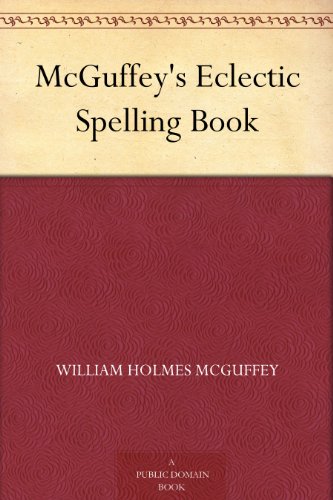
eBook Review: McGuffey's Eclectic Spelling Book et alia


William Holmes McGuffey, McGuffey's Eclectic Spelling Book

Product Details

  • File Size: 149 KB
  • Print Length: 152 pages
  • Simultaneous Device Usage: Unlimited
  • Sold by: Amazon Digital Services, Inc.
  • Language: English
  • ASIN: B004TRTFK6
  • Text-to-Speech: Enabled
  • Lending: Enabled
  • Average Customer Review: 3.8 out of 5 stars (6 customer reviews)
  • Price: $0.00 (FREE)
1. Short review:    (Amazon rating: 1 out of 5 stars -- I hate it. If I could give it 0 stars, I would.)

2. Long review:
2.1. What I liked:  Nothing.
Roller-coaster or walk-in-the-park? Should be a walk in the park but it is a mugging in an alley.

2.2. What I did not like: The lack of illustrations. The original had illustrations. In place of each is now a barren statement of [Figure].
The terrible formatting. The formatting was so bad that it made the book unreadable.

2.3. Who I think is the audience: For the original, the audience is esoteric historians and homeschoolers. For this version, only masochists need download it.

2.4. Is the book appropriate for children to read?  No. A thousand times "NO!"

2.5. On the basis of reading this book, will I buy the author's next book? No.

2.6. The plot in a nutshell:
     There is no plot. McGuffey's Eclectic Spelling Book was used as a grammar school textbook in the 19th century in the US.
2.7. Other:
     I also downloaded and perused the following:
McGuffey's First Eclectic Reader, Revised Edition;
McGuffey's Second Eclectic Reader;
McGuffey's Third Eclectic Reader;
McGuffey's Fourth Eclectic Reader;
McGuffey's Fifth Eclectic Reader; and
McGuffey's Sixth Eclectic Reader.
     One and all suffer from the same faults as the Spelling Book: They lack illustrations and the formatting is so bad as to render the book unusable.
     In spite of this, I highly recommend McGuffey's books -- just not the Amazon Kindle versions. Instead, go to the Gutenberg Project and download the PDF versions. Do not waste your time downloading another version. Get the PDF versions.
     I added a bonus book: McGuffey's Eclectic Primer, Revised Edition.

2.8. Links: (All links to the Gutenberg Project.)

2.9. Buy the book: I shall not give you a link to McGuffey's Eclectic Spelling Book on Amazon. You deserve better. Use the Gutenberg Project links above.